Dirt on Their Hands and a Spoon in Their Fist: Raising Little Southern Cooks the Easy Way
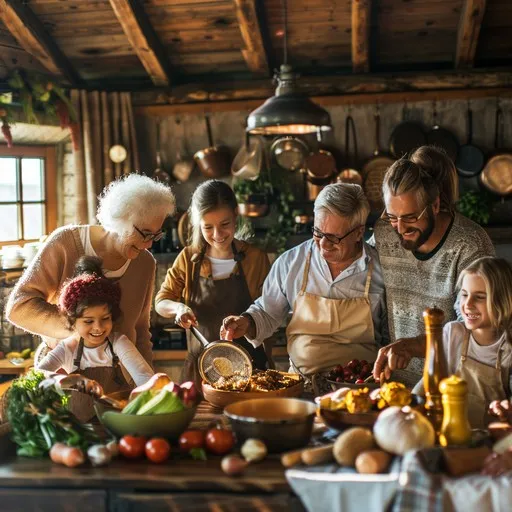
Photo: child cooking outdoors with grandparent Southern style rustic kitchen, via images.stockcake.com
Somewhere along the way, we started treating cooking like a subject to be taught rather than something to be lived. We pulled out the measuring spoons, printed off the instructions, and turned the kitchen into a classroom. And then we wondered why the kids lost interest by step three.
Southern cooking was never designed to work that way. It was built in kitchens where children were underfoot from the time they could walk, where learning happened by watching and tasting and being handed a spoon without much explanation. Nobody sat a kid down with a worksheet about biscuit dough. They just handed over the bowl.
If you want to raise a child who actually loves to cook, the first thing you've got to do is loosen up. The second thing is take off your shoes.
The Problem With Perfect
Perfectionism is the fastest way to kill a kid's interest in the kitchen. When every measurement has to be exact and every result has to look like the picture, cooking stops being fun and starts being stressful. And stressed-out kids don't come back for more.
Here's the truth about Southern cooking that experienced home cooks already know: most of it is forgiving. Cornbread that's a little too thick still tastes like cornbread. Biscuits that don't rise quite right still taste like biscuits. A pot of beans that simmered a little long gets thicker, not ruined. The food absorbs a lot of mistakes and comes out fine on the other side.
When you let kids cook inside that forgiving margin—when you stop hovering and correcting and recalibrating—something shifts. They start to trust themselves. They taste as they go. They make adjustments. They figure out that cooking is responsive, not rigid. That's a skill no recipe card can teach.
Start Outside
If the kitchen feels like a formal space—somewhere things can break and messes are a problem—move the operation outdoors. A picnic table, a camp stove, a cast iron skillet, and some basic ingredients is all you need to make cooking feel like an adventure instead of a chore.
Outdoor cooking naturally lowers the stakes. There's no countertop to worry about, no floor to stain, no cabinet doors to slam. Kids can stir vigorously without consequences. They can spill things and it doesn't matter. They can crouch down and watch a fire or a gas flame do its work in a way that an indoor stove doesn't quite allow.
Start simple: scrambled eggs over a camp stove, cornbread in a cast iron skillet over an open fire, boiled peanuts in a big pot with nothing but salt and water and time. These aren't dumbed-down recipes. They're real Southern cooking, and kids can handle every step with a little supervision.
Give Them the Messy Jobs First
Children are drawn to tasks with texture and motion. Shelling butter beans. Snapping green beans. Kneading dough. Stirring something thick. Mashing potatoes by hand. These are the jobs that feel like play because they involve their whole body, and they happen to be the same jobs that generations of Southern kids were put to work doing before they were old enough to reach the stove.
Don't make them earn their way to the fun stuff by sitting through explanations. Start with the hands-on work. Let them feel what overworked biscuit dough is like versus dough that was barely touched. Let them taste a raw snap bean and then a cooked one. Let them smell what garlic does when it hits a hot pan. Cooking is sensory before it's technical, and kids are natural sensors.
Recipes Are Suggestions
One of the best things you can do for a young cook is hand them a recipe and tell them they don't have to follow it exactly. Show them the general shape of what you're making—the ratio of wet to dry, the basic order of operations—and then step back.
Let them add more pepper if they want to. Let them swap out one vegetable for another. Let them decide if the soup needs more salt. These small decisions build confidence faster than perfect execution ever could, because they're making choices and seeing results. When the soup is good, they know they made it good. That ownership matters.
This is how Southern cooks have always worked. The recipe was the starting point, not the finish line.
The Traditions That Stick
Readers of Barefoot Bubba's have shared some beautiful stories about how cooking got passed down in their families, and the common thread is almost never formal instruction.
One reader from Alabama remembers learning to make her grandmother's tea cakes by standing on a step stool and doing whatever she was told, which mostly involved pressing the dough flat with her palm and cutting circles with an old jelly glass. "She never measured anything," she wrote. "She'd just look at the dough and know. I didn't understand that until I was about forty and suddenly my hands knew too."
A reader from Louisiana described his grandfather teaching him to make roux at age seven. "He stood right behind me and talked me through it the whole time. Never touched the spoon. He said if I burned it, we'd just start over. We started over twice. By the third one I had it, and I've never forgotten."
Another reader talked about her tradition of letting her kids make Sunday biscuits completely unsupervised from the time they were eight years old. "They were terrible at first. Flat, tough, burned on the bottom. But by the time my oldest was twelve, his biscuits were better than mine. I never told him how to fix anything. He figured it out himself."
What They're Really Learning
When you teach a child to cook without rules or pressure, you're teaching them more than food. You're teaching them that mistakes are workable. That patience has a payoff—you can smell it, taste it, serve it. That taking care of people through food is one of the most straightforward and satisfying things a person can do.
Southern cooking has always been about feeding people you love with what you've got. That's not a technique. It's a value. And kids pick it up the same way they pick up everything that matters—by watching the people around them live it out, barefoot on a back porch, stirring something that smells like home.