Nobody Told You the Rules Because You Were Supposed to Already Know Them
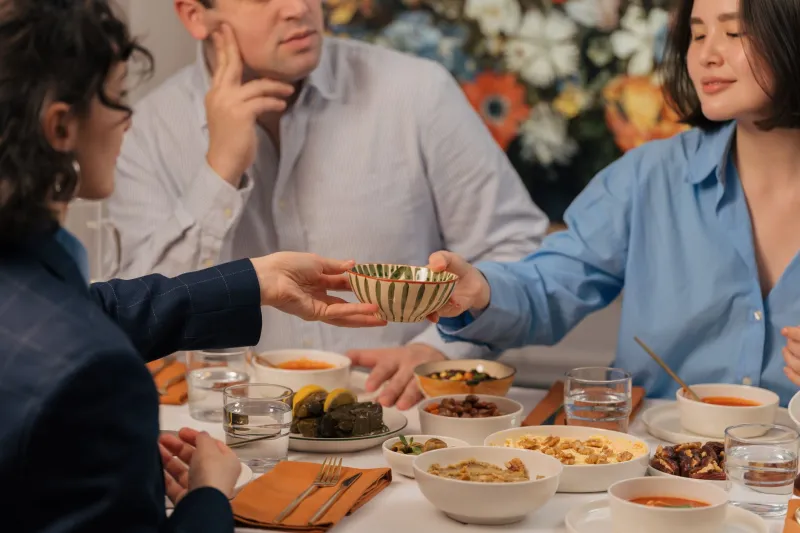
There was no orientation. No printed guide slipped under your plate. Nobody sat you down and explained the order of things. You just watched, and eventually you understood. That's how table manners work in a Southern household—not as a checklist of dos and don'ts, but as a living, breathing rhythm that everybody falls into without being told.
If you grew up eating supper in the South, you already know what we're talking about. And if you married into a Southern family, you probably spent a few meals feeling like you'd wandered into a play where everyone else knew their lines.
The Biscuit Economy
Let's start with the biscuits, because they tell you everything.
In most Southern homes, the biscuits don't travel until the oldest person at the table takes one. It's not a law. Nobody says it. But you pass them wrong once and you'll feel the pause in the room—brief, barely there, but unmistakable. The biscuit basket is a small ceremony, and the order in which it moves around the table maps out the social architecture of the whole gathering.
Elders first. Always. Not because they're slow or need extra time, but because respect at the Southern table is expressed through sequence. Who gets served, in what order, says more than any toast ever could.
This extends to the sweet tea. If Grandma's glass is empty and you notice it before she has to ask, you've passed a test you didn't know you were taking. Fill it. Don't make a thing of it. Just fill it.
Seating Isn't Random
That chair at the head of the table? It's not just a chair. It belongs to someone, and everybody in the room knows who. You don't sit there. Not even if it's empty. Not even if it's been empty for years.
Southern families hold onto seating arrangements the way they hold onto land—like something worth protecting. Your spot at the table is yours in a way that feels almost genetic. The cousins cluster together. The in-laws find their place somewhere near the middle. The person who cooked gets the seat closest to the kitchen, so they can jump up without making a scene.
When new people come to the table—a boyfriend, a new spouse, a neighbor who got invited and said yes—they get placed with care. Where you put someone tells them how you feel about them. Near the center means you're glad they're there. Tucked at the far end near the kids means the jury's still out.
When to Talk, When to Eat, and When to Do Both
The Southern table is not a quiet place. It is loud and overlapping and occasionally chaotic in the best possible way. But there's a timing to it that takes some getting used to.
You don't bring up money, health problems, or anything that might make someone lose their appetite until the plates are mostly cleared. This isn't squeamishness—it's hospitality. The meal is a gift, and you don't unwrap someone else's bad news in the middle of it. There's time for that later, out on the porch, with a glass of something cold.
Complimenting the food is not optional. It is a social obligation, and a sincere one. If somebody cooked for you, you say something about it. You be specific. "This cornbread is good" is fine. "I don't know what you put in this cornbread but I need the recipe" is better. The cook worked hard. They're watching your face when you take the first bite. Don't make them wait.
And if the food isn't your favorite? You eat it anyway. Quietly. With a smile. You find something on that table you can praise and you praise it.
The Art of the Second Helping
Refusing a second helping too quickly is a form of insult that most Southerners would never name out loud but absolutely feel. When someone offers you more, the correct response is a pause, a moment of visible consideration, and then either a genuine yes or a "I would but I want to save room for that pie" type of no. You are not simply declining food. You are communicating that the meal was worth lingering over.
The host will offer three times. This is not excessive—it's the form. The first offer is the invitation. The second offer means they mean it. The third offer means they really, really mean it, and also there's plenty, and also please eat more.
Leaving the Table
You don't leave the table until the oldest person does, or until you've asked to be excused. This one actually does get said out loud, usually to children, but it applies to adults too in a softer way. Getting up and walking off while others are still eating communicates that you have somewhere better to be. At a Southern table, there is no better place to be.
When the meal is winding down, somebody will start stacking plates without being asked. That's the signal. The table begins to clear itself through a kind of collective choreography—some people carry dishes, some cover the leftovers, some just stand around talking while they pretend to help. It all works out.
What It All Actually Means
None of these rules are about formality. That's the thing that trips people up. Southern table etiquette looks like manners from the outside, but from the inside, it's something else entirely—it's a way of saying you matter here without having to use those words.
Passing the biscuits in the right order. Filling the glass without being asked. Staying in your seat until the meal is really over. These are small acts, and they add up to something large. They add up to belonging.
And nobody had to tell you that. You were supposed to already know.