Stashed Everywhere on Purpose: The Real Logic Behind the Southern Duplicate Pantry
Walk into most Southern homes and you'll find food in places that would baffle a minimalist. There's a shelf in the garage with cooking oil, dried beans, and enough canned tomatoes to outlast a minor disaster. There's a cabinet on the back porch holding cornmeal, hot sauce, and a spare jar of peanut butter. The kitchen has its own full setup, of course. And somewhere in a hall closet, behind the extra toilet paper, there's a bag of grits that nobody remembers buying.
This isn't disorganization. It's a deeply intentional habit with real roots—and real costs, if you're not careful about it.
Where the Habit Comes From
The Southern duplicate pantry didn't start as a quirk. It started as a survival strategy. Families who lived far from town, who canned their own vegetables, who hosted unexpected guests regularly, or who simply couldn't afford to run out of something mid-week learned early that having one of anything was a gamble. Having two—or three—was just being sensible.
Add to that the cultural reality of Southern entertaining. When people show up, you feed them. When the power goes out, you cook anyway. When the garden comes in all at once, you need the infrastructure to process it. A single kitchen pantry isn't built for any of that. So the overflow went to the porch, the garage, the shed, the mudroom—wherever there was a cool, dry corner that could hold a few extra pounds of flour.
Generations later, the habit stuck even as the necessity softened. Now it's less about survival and more about comfort, identity, and the quiet satisfaction of knowing you're covered no matter what walks through the door.
When It Actually Makes Sense
Let's be honest: the duplicate pantry system genuinely works under the right conditions. Here's when it earns its keep.
You cook in volume. If you're regularly feeding a crowd, smoking a whole pork shoulder for the neighborhood, or putting up preserves every fall, bulk storage isn't excess—it's efficiency. Buying in quantity when prices are right and spreading that stock across your available space is smart household economics.
You live somewhere with unpredictable supply. Rural areas, places prone to weather disruptions, or communities where grocery runs are a thirty-minute drive each way—these are exactly the environments the duplicate pantry was designed for. Running out of vegetable shortening when the nearest store is forty miles away is a real problem. Having a backup isn't paranoia; it's geography.
You rotate your stock properly. The system works beautifully when older items get used before newer ones get opened. A well-managed duplicate pantry is essentially a private grocery store where you're both the buyer and the cashier.
When It Starts Costing You
Here's the part nobody likes to talk about. The duplicate pantry can quietly become a money drain, and it usually does so in ways that are hard to see until you do an honest accounting.
Expired goods you never notice. That second bag of self-rising flour in the garage? It's been there since before your youngest started middle school. Canned goods have long shelf lives, but they're not immortal—and dry goods like flour, cornmeal, and spices lose quality faster than most people realize, especially when stored somewhere with temperature swings like a garage or an outdoor shed.
Duplicate purchases you don't track. If you can't remember what's in the back porch cabinet, you'll buy more of it at the store. That's not stocking up; that's paying twice for the same thing. Over a year, this kind of invisible overlap can add up to a surprising amount of wasted grocery money.
Space that creates clutter, not convenience. When storage areas become overstuffed and disorganized, people stop going to them. A porch pantry you can't navigate easily stops functioning as a pantry and starts functioning as a pile. At that point, you're not maintaining a system—you're just hoarding canned goods in inconvenient locations.
What a Balanced System Actually Looks Like
The goal isn't to eliminate the duplicate pantry. The goal is to make it intentional instead of accidental.
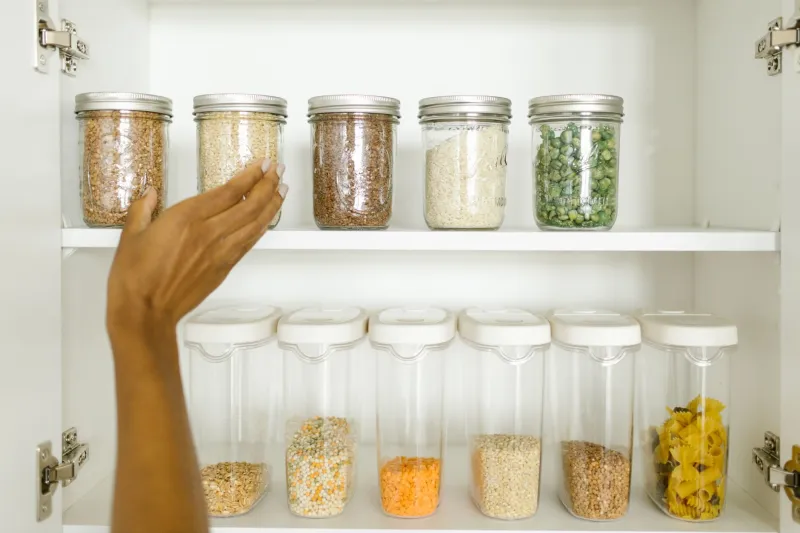
Start by treating each storage location as a distinct zone with a specific purpose. The kitchen pantry holds what you use daily and weekly. The garage or porch holds bulk backups of non-perishables—things you buy in quantity when they're on sale and draw down over time. The shed, if you use it for food storage at all, should hold only the most shelf-stable items and be checked seasonally.
Then build in a rotation habit. Every time you bring something new into the house, spend two minutes moving older stock to the front. It doesn't have to be complicated. A marker and a date on the lid of a jar goes a long way.
Finally, do a real audit at least twice a year. Pull everything out, check dates, consolidate duplicates, and get honest about what you actually use versus what you keep buying out of habit. Most people find at least one category of food they've been stockpiling without ever really cooking—and that's the first place to stop spending.
The Number That Might Surprise You
A loose audit of a typical Southern household with an active duplicate pantry setup—garage shelves, porch cabinet, and full kitchen—often reveals somewhere between $200 and $600 in stored food at any given time. That's not a problem if the food is getting used. But if even a quarter of it expires or gets thrown out annually, you're looking at $50 to $150 in quiet annual waste that never shows up on a budget spreadsheet.
For most families, that's not a reason to abandon the system. It's a reason to tighten it up.
Keep the Habit, Sharpen the System
The Southern duplicate pantry is one of those traditions that makes more sense the closer you look at it. It's practical, it's culturally grounded, and it genuinely solves real problems—as long as you're managing it rather than letting it manage you.
Know what you have. Know where it is. Know when it expires. Rotate it, use it, and buy more when it makes financial sense to do so. That's the whole system, really. Everything else is just shelf space.